

AMD Navi: Filtered the first benchmark of its new graphics based on Navi 14


They have leaked the CompuBecnh benchmark, a graphics card based on the RND + GCN architecture under TSMC's 7nm lithography.
Currently in the graphics card market we have the AMD RX 5700 Series based on Navi 10. This silicon is based on 7nm lithography and we do not know anything about other versions. A few days ago data from a possible Navi 14 was filtered and now the first benchmarks have been filtered. These new graphics will have between 4GB and 8GB of RAM.
Navi graphics cards are based on RDNA architecture combined with GCN. Navi is not yet a complete RDNA architecture, but it already shows the power of the new architecture. Navi 14 would have been designed for the lower-mid range, being the replacement for the RX 570. It will have to compete with the GeForce GTX 16 Series, the models without NVIDIA RayTracing.
Filtered an AMD Navi 14 intended for the lower-mid range
CompuBench shows the Navi 14 with 12 Compute Units. It's worth noting that this tool doesn't always accurately reflect the 24 Compute Units actually available for graphics cards. The RX 5700 XT has 40 Compute Units, and the RX 5700 has 36. Therefore, the new Navi 14 will be a significantly scaled-down version.
Regarding performance, it is difficult to draw conclusions, but it does let us see some relevant data. The first is that this Navi 14 is between the RX 1650 and the RX 1660. So the possibility that NVIDIA will launch the GTX 1650 Ti seems logical.

It should be noted that AMD has stopped producing the Vega architecture graphics. Vega is currently only used in the company's APUs. It is expected that next year the Navi 20 will be launched, which would already be completely from RDNA. The truth is that replacing the RX 5700 with a new and more efficient model is very interesting.
Currently in the graphics card market we have the AMD RX 5700 Series based on Navi 10. This silicon is based on 7nm lithography and we do not know anything about other versions. A few days ago data from a possible Navi 14 was filtered and now the first benchmarks have been filtered. These new graphics will have between 4GB and 8GB of RAM.
Navi graphics cards are based on RDNA architecture combined with GCN. Navi is not yet a complete RDNA architecture, but it already shows the power of the new architecture. Navi 14 would have been designed for the lower-mid range, being the replacement for the RX 570. It will have to compete with the GeForce GTX 16 Series, the models without NVIDIA RayTracing.
Filtered an AMD Navi 14 intended for the lower-mid range
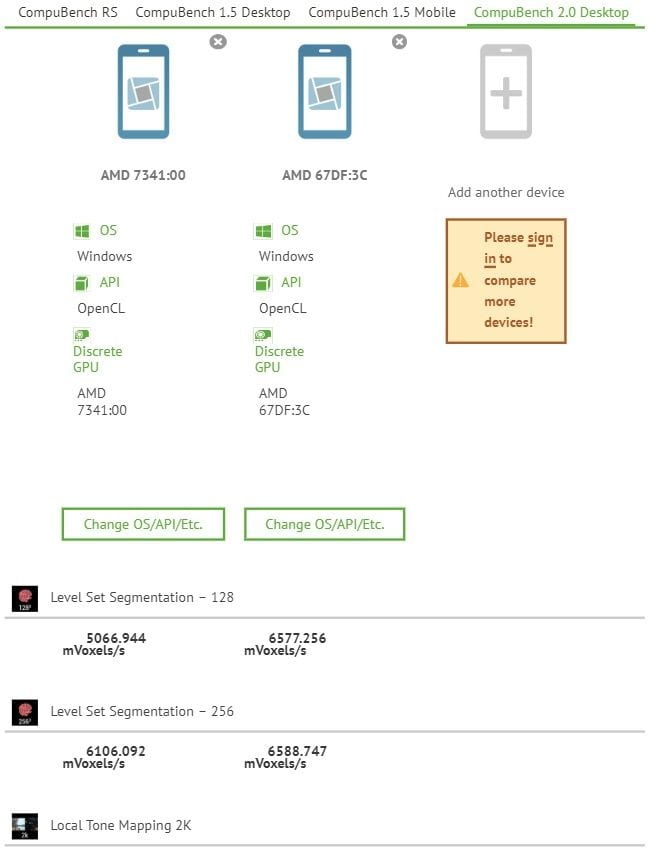
CompuBench shows us the Navi 14 that would have 12 Compute Units. Note that this tool does not work well with the graphs, with 24 Compute Units, really. The RX 5700 XT has a total of 40 Compute Units and the RX 5700 has 36 Compute Units. So the new Navi 14 graphics will be a very reduced version.
Regarding performance, it is difficult to draw conclusions, but it does let us see some relevant data. The first is that this Navi 14 is between the RTX 1650 and the RTX 1660. So the possibility of NVIDIA launching the GTX 1650 Ti seems logical.
It should be noted that AMD has stopped producing the Vega architecture graphics. Vega is currently only used in the company's APUs. It is expected that next year the Navi 20 will be launched, which would already be completely from RDNA. The truth is that replacing the RX 5700 with a new and more efficient model is very interesting.


