

Battlefield V Shows How Ray Tracing Negatively Affects NVIDIA GeForce RTX Performance


The first Battlefield V benchmarks with Ray Tracing from the NVIDIA GeForce RTX show a sharp drop in frames compared to the disabled technology.
The first game to natively support Ray Tracing is Battlefield V which is already on the market and is one of the great games. This is the first game to support the DXR and RT technologies that are integrated into the new GeForce RTX from NVIDIA. The first benchmarks show a significant performance drop, although I was singing because the computational use of this technology is much higher than any other existing today.
Battlefield V is the first game to allow Ray Tracing with the NVIDIA GeForce RTX.
This technology not only affects the performance of the GPU, it also makes intensive use of VRAM memories, causing an increase in the consumption of this memory of between 1.1GB and 1.5GB, something that was also within expectations. DirectX Ray Tracing (DXR) consumes more memory than DX12, something that was within the premises.

If we look at the performance in 1080p resolutions, we see that the performance is not bad and is always above 30FPS although the only one capable of exceeding 60FPS is the 2080 Ti at full Ray Tracing capacity. Despite everything, there is a performance drop of over 59% on the RTX 2080 Ti, 55% on the RTX 2080 and 58% on the RTX 2070, when compared without the Ray Tracing function active.
If we look at 2K resolutions, the differences in terms of performance drop increase a little, being an average of around 60% in all GeForce RTX models. Which seems to indicate that the performance of the graphics card at the moment is greatly affected by this technology the higher the resolution. The 4K resolution shows more or less the same drop in frame rate.
Despite all this, this data is normal and it is possible that with future optimizations of the game through DICE updates and improvements through drivers, this situation will be corrected and performance improved. It should be noted that with PhysX and Tesselation the same thing happened at the beginning, the performance with these technologies suffered strong performance drops.
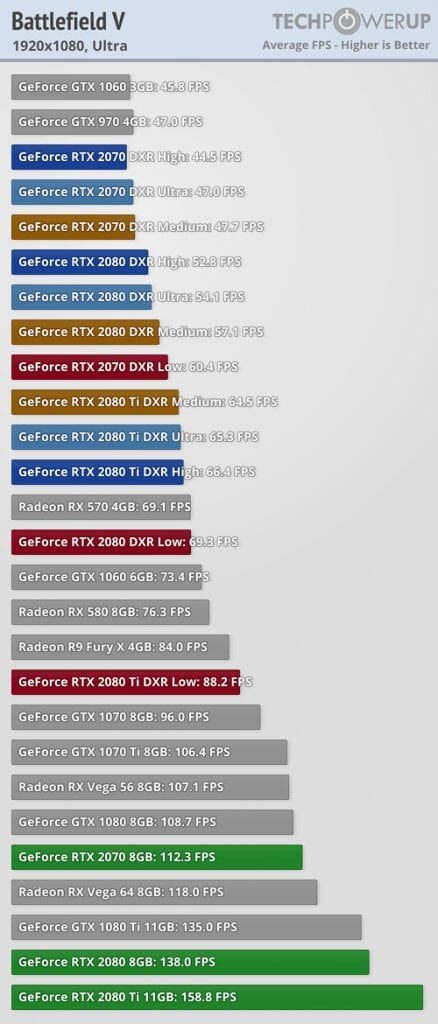

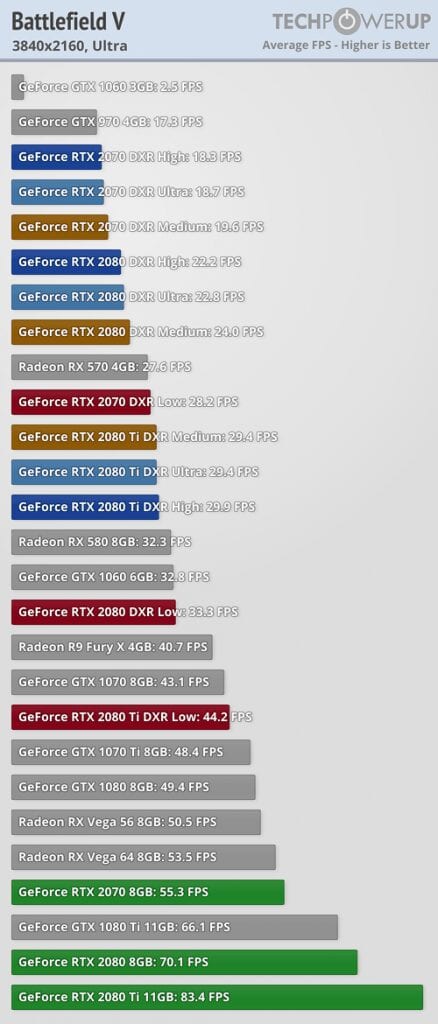
Source: TPU


