


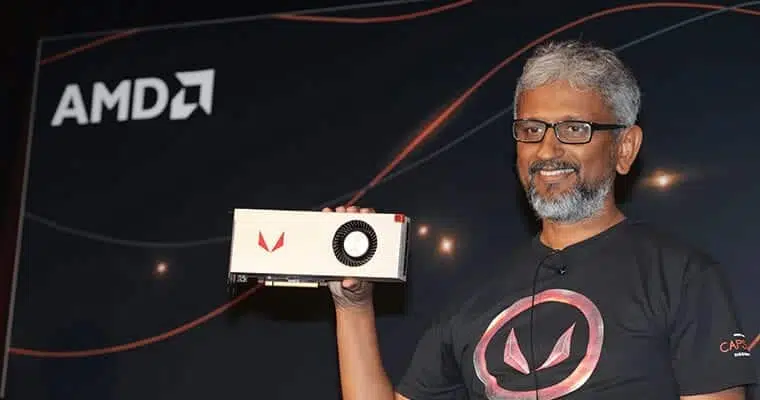
Interesting concatenation of movements that have occurred this past week, such as the announcement of the Intel-AMD MCM, the farewell letter from Raja Koduri and the subsequent announcement of his signing by Intel.
I have spent several days turning to the last two plays of Intel and the truth, every time I review it mentally, many questions assail me. The signing of Raja Koduri does not surprise me, and here one of Intel's weakest points is its integrated graphics, which speaking in silver, are garbage, they only serve to play videos and little else, if you want to play, than less than one RX 460 or a GTX 1050, a discrete graphics that can move a game smoothly at 1080p. The other movement that leaves me in a sea of doubts is that of the chip with Kaby Lake CPU and Vega GPU.
The chip seems interesting to me and it is a risky bet on the part of Intel and it should be noted that we arrived all summer with rumors about a processor with AMD graphics, something that has been confirmed and that everyone saw as madness or invention. I am surprised at this point that Intel is now betting on this move for several reasons. The first is that at the moment AMD is cutting ground with the Ryzen, Threadripper and EPYC processors, which in performance are in some respects below the Intel, but which devastate in price and we already know that the pocket is important in any decision .

AMD has to launch shortly (we have been with the happy tune for months), the Raven Ridge APUs, which carry Zen cores like Ryzen and Vega graphics. What surprises me about the play, is how AMD has played a card that apparently may seem absurd, because it is throwing stones on its roof, since the solutions developed with Intel compete with its APUs, but it is masterful. It is simply a master, because AMD places graphics where it did not have access before and with this solution NVIDIA is removed from the middle, gaining ground.
The two companies have played with cost, size and versatility. Installing a GPU requires duplicate cooling and increasing the size, which leads to increased consumption and also development costs. Having a powerful processor and graphics in a package that you can easily cool with a single heat dissipation system reduces costs enormously and these chips may also cost less than an Intel processor and have to go buy a GPU from NVIDIA.
Clearly this play hurts NVIDIA, benefits Intel, because many laptop manufacturers will surely opt for this option and AMD claps its ears as it gains market share, makes extra money and takes NVIDIA out of the way. Better impossible. The only negative factor in the whole play is Vega. We know that the Vega architecture is not exactly the best in the world, we just need to see our review of the RX Vega 64 or any review and see that they have a serious consumption problem and that led to laptops is a problem, because what everyone is looking for laptops is autonomy, a problem that has been stagnant for years and it is impossible to find a laptop that has eight hours of autonomy and does not cost a kidney.

The person responsible for the development of Vega was none other than Raja Koduri. The chain of events has been as follows: Mark Durcan, former CEO of Micron joins AMD, the Intel-AMD hybrid processor is announced, the farewell letter from Raja Koduri and the announcement from Intel with the signing of Raja Koduri. There is a precedent, which starts in September and is the 'vacation' that Koduri takes. The way I see it is: Vega is not planned and AMD wants to get him out of the way, so he sends him to the bench. The agreement with Intel was almost closed and at some point Koduri entered the agreement. Everything is covered up to have a viable prototype developed from the Intel-AMD MCM. Koduri is still at AMD while they count on a replacement, which is Durcan and they announce him. Then the Intel-AMD MCM is announced, which leaves the door open to the leak of Koduri's farewell letter and the announcement of Intel, who claims to have signed him to develop its graphics cards.
Regarding Intel graphics cards, this song is very old and very tiresome, on the other hand. We already saw how Larrabee was left with absolutely nothing, basically, because Intel had problems in the development of a GPU, since AMD and NVIDIA have many patents and developing something that does not infringe patents, is not easy, a clear example is that AMD sued Intel years ago for its iGPUs and everything was closed in a multi-million dollar deal. Returning to this issue for Intel is a risk and honestly, I think they are going to start by improving their iGPU, they are not going to develop dedicated graphics for the first shift, I think Intel's idea is to start by competing with AMD APUs.

Koduri benefits from this dance of stickers. Vega's problem is based, in my view, on two factors: time and money. AMD was already on the ropes, because Pascal went over and much of the Polaris, so in a hurry and with a lower budget than the competition, Vega was developed, which has gone as it has, with delays, late and quite bad . The mining of cryptocurrencies, although it has liquidated the stock of AMD graphics of multiple models and families, has not solved the problem, on the contrary, it has worsened the problem, because there were no AMD graphics in the market and those that had were available. crazy prices, which forced AMD to run even more with its graphics cards.
We see how Koduri will now have time, because Intel is not in the graphics market and although it has always been crazy to get into this market, the attempts have been null and it will possibly give it time to develop something powerful and most importantly , money. Intel has possibly promised you a blank check and a powerful and safe equipment that Koduri makes good use of and his knowledge acquired in his AMD stage will be highly valued.


https://uploads.disquscdn.com/images/57e06a35f61520485b87970f3f6065039bcda347db52c860de1ac19844191a2c.png
Sorry to contradict you. The RX Vega do not heat up, curiously the heatsink is very good and the temperature does not exceed 65ºC, a very good temperature for a graph, the problem is that they consume an aberration.
I had hardly noticed.