


Problems for manufacturers that develop custom models of the AMD RX Vega 64, because there is a height difference between the GPU and the HBM2 memories that would generate temperature problems.
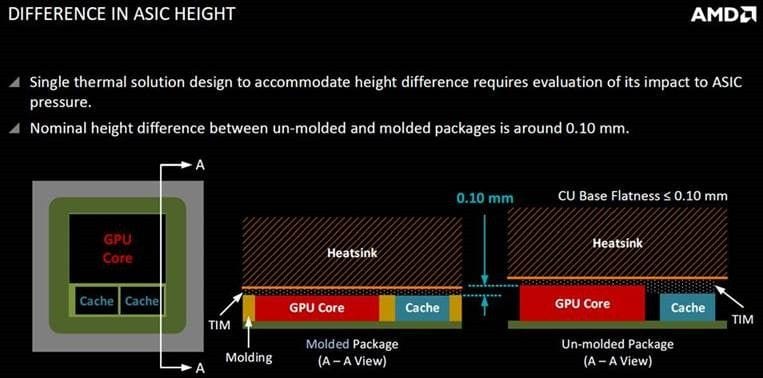
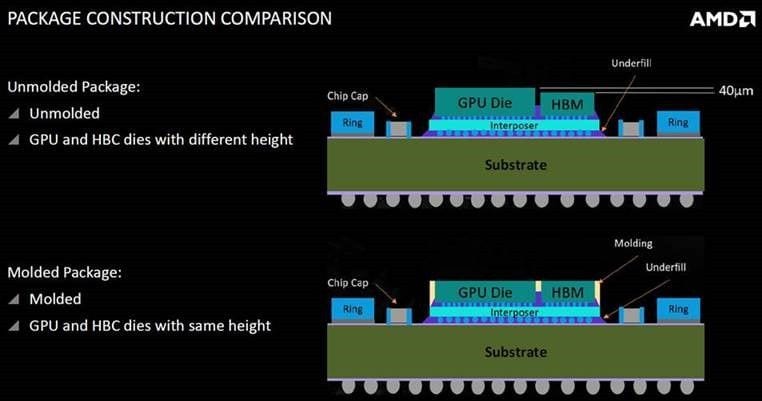
In the end there are not only two versions of the Vega 10 GPUs, since according to Tom's Hardware there are at least three variants of these GPU models. Depending on when and where they were manufactured, these graphics cards have three different aspects. The big difference is in the inclusion of epoxy resin or not. Chips without resin are more difficult to use in custom models because the GPU is taller than HBM2 modules. The difference is 0.1mm, enough so that the heatsink does touch the GPU but not the memories. In addition to the three models for the RX Vega 64, there is a fourth model for the RX Vega 56.

The first model has epoxy resin coating everything, which offers a uniform design and has Samsung HBM2 memories. This model is the same as the one used in the Frontier Edition and the PCB is the same as well, so much so that if we look at the serial number of the PCB next to the PCIe port and look for images of the Frontier Edition, we will see that the number is the same, which indicates that AMD has changed the heatsink and voila. There is a second version without resin for the RX Vega 64, but it does not differ in practically anything from the resin model, except for the difference in height between the GPU and the HBM2.
The other two models are based on the model for Vega 56 without resin and manufactured in South Korea (the GPU for Vega 64 is manufactured in Taiwan) and the HBM2 memories are from SK Hynix. The other existing model has been manufactured in Taiwan and is somewhat more rudimentary, without resin and only for engineering graphics. Not much more is specified, but it shows something that is a less elegant model, more for work.
MOLDED AND UNMOLDED
AMD has created several different GPUs and that is a very significant problem for brands releasing custom models. We may think 0.1mm is silly, but it is giving AMD partners a lot of headaches. The company's partners, according to Tom's Hardware, are working on the joints using different screw lengths to avoid temperature problems. For the GPU it is not a problem, since it contacts the base of the heatsink, but that minimal difference avoids direct contact with the heatsink, which generates poor and inefficient cooling. Tom's Hardware has published some images where this problem is seen.

Source: THFR


Q claje shit AMD, don't go crazy buying these graphics, wait for a new revision, but I wonder is it the fault of AMD or the companies that are making these cards?
amd no more
too bad they don't have enough money to do things right
And making the dissipation part of the memories 0,1mm longer wouldn't solve the problem?
Its not that easy. The amount of surface area is very small and adjusting the heatsink is complicated and expensive. This could also cause that when the heatsink is removed to clean it and change the thermal paste, the user could place it incorrectly and break the memories or the GPU, with which we already have a mess.
How can I know which model has touched me? I have the Vega 56
We do not have data for Vega 56, this is a reference to Vega 64